

Women face significant social and economic challenges in Uganda because they tend not to be valued and supported across society. The following three stories show husbands who are modeling a behavior that should be more widely embraced, and they deserve to be seen and acknowledged.
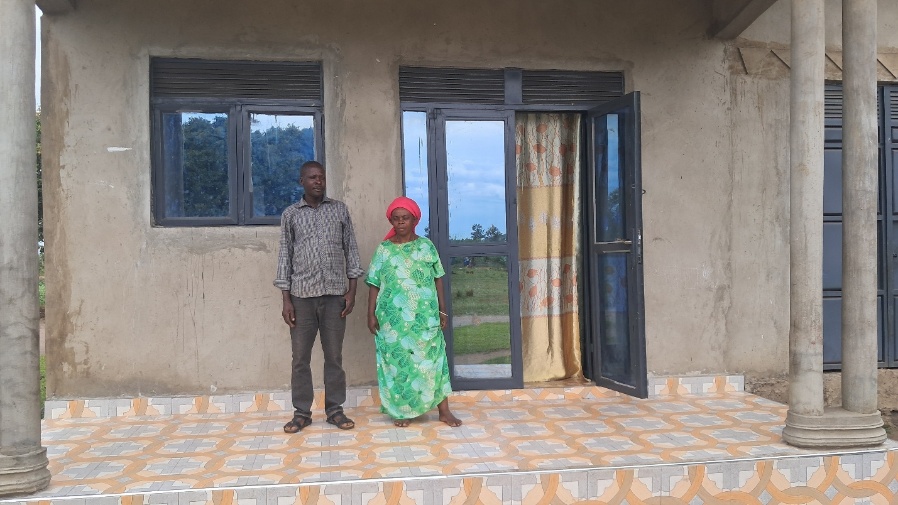
Edith Kyamukama, client of RDF
Edith Kyamukama, 52, is a fisher woman who lives in Nakigga village in Central Uganda and fishes the waters of Lake Victoria. She has been fishing for many years and started fishing for herself in 2020 with a single boat and a rented engine.
In 2024, Edith got her first loan of $350 from RDF, an Envest partner, which she used to purchase fishing nets. The increased profits from the fishing nets allowed her to buy two additional boats. Her second loan of $1,100 was used to buy additional fishing nets and rent two additional engines. Edith’s business directly employs 10 people, and indirectly supports another 50, including drivers and fish sellers. Edith plans to have 10 boats with engines in the next 10 years.
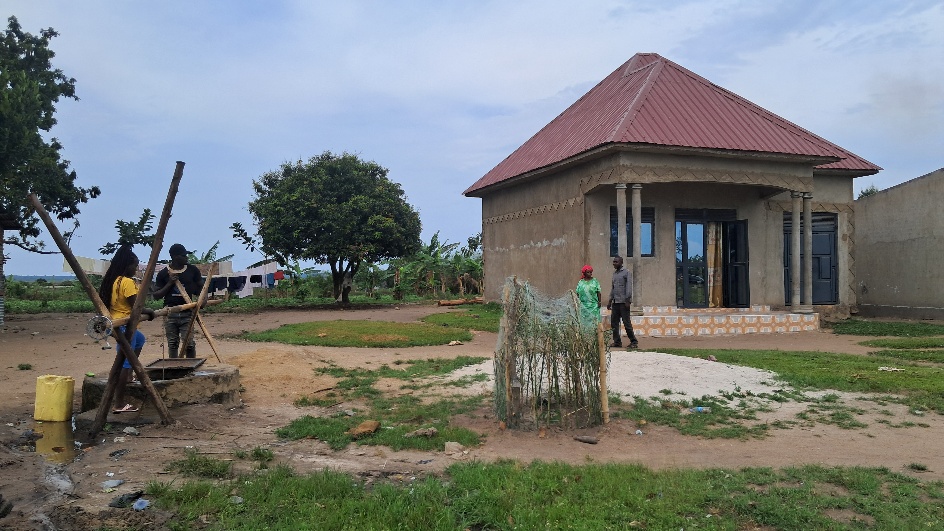
Edith’s husband, Caleb Tayebwa, works in her fishing business and proudly supports her. Together they smoke most of the catch and export it to the Democratic Republic of Congo. Edith and Caleb have been married for over 28 years and have four children (27, 17, 10, & 5 years old); two are studying and two are working. Through the income from her business, Edith has built a family home and is able to pay for school fees for her children. Edith and Caleb also own a small bar bought with fishing profits that awaits a loan for repairs.
Edith also gives back to her community by mentoring other entrepreneurs in the community in fishing and other business activities. She refers those in need of credit to RDF. Edith built a community well that provides water for many surrounding families and has enough to sustain her family, workers, and business, which is an example of how her success has strengthened not only her household but also her community.
Molly Tusiimirwe, client of Kigarama Farmers SACCO
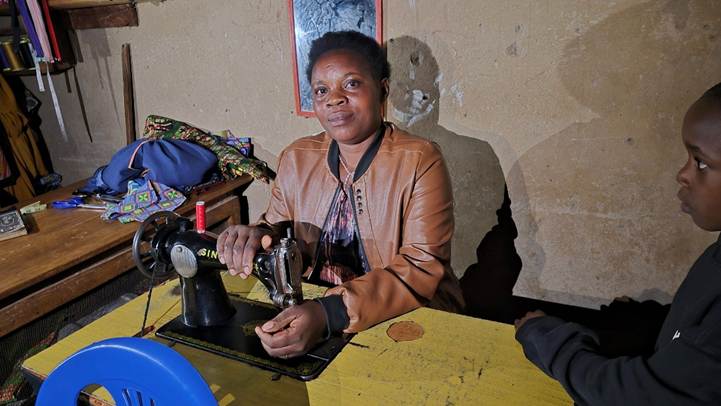
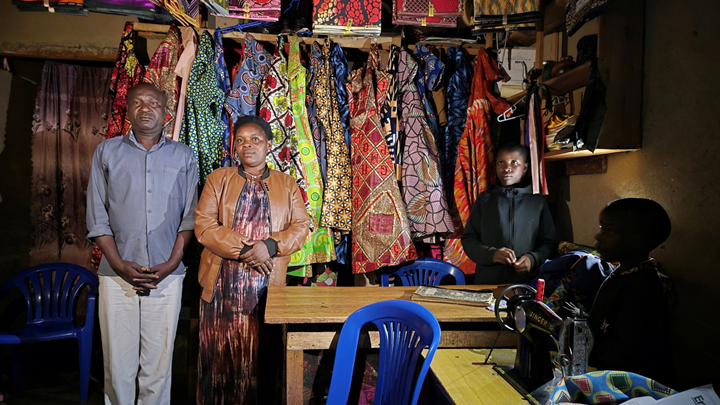
Molly Tusiimirwe, 38, is a tailor in Katoozo Village, a rural area characterized by banana and coffee groves, in Southwestern Uganda. Molly makes clothes in a variety of fashions with an emphasis on kitenge, a traditional East and West African dress, and she trains apprentices in tailoring. Molly started borrowing from Envest’s partner Kigarama Farmers SACCO in 2018 with a loan of $400 after hearing about the SACCO from farmers in her community. Her current loan from Kigarama of $1,400 was used to buy two more sewing machines and additional cloth and sewing materials. She has five sewing machines, which she uses to train four apprentices. Molly and her husband, Innocent, a banana farmer, have five children (16, 14, 13, 7 & 2 years old), four of whom are in school. Innocent supports Molly by providing his banana plantation as collateral for her loan. Business is good for Molly. She can sell as many dresses as she can produce. Credit is the limiting factor. Molly’s business increases the family income, and it diversifies it so that the family is less vulnerable to fluctuations in the banana harvest. She intends to continue borrowing from Kigarama Farmers SACCO with a vision to expand her business.
Loni Mumpe, client of DMF
Loni Mumpe, 32, is a mechanic who owns an auto parts store and car repair shop just outside of Kampala, Uganda. He received his first loan of $135 from Development Microfinance (DMF), an Envest partner, as a member of a lending group comprised of workers in a stone quarry. In Uganda, quarry work is an entrepreneurial activity, with small groups contracting with landowners to extract construction material. Group members access credit together and cosign on each other’s’ loan, which is a standard practice in microfinance when individual collateral is limited. Through his work at the quarry and participation in the lending group, Loni established a track record with DMF, which qualified him for an individual loan. In 2022, Loni combined his quarry profits with a $280 loan from DMF to open an auto parts shop. He continues to borrow from DMF to grow his business.
Loni also used quarry profits to finance the opening of a beauty salon for his wife, Patience Kyalimpa. Together, they are able to pay school fees for their two children. Loni says without DMF, he would not have been able to start his own business nor that of his wife. The DMF team said that it is common for quarry workers to earn enough money to buy property and begin a business in a different line of work. DMF often continues lending to borrowers such as Loni when they transition to other activities. The trust established while borrowing as part of the quarry group allows DMF and the clients to continue the lending relationship seamlessly.
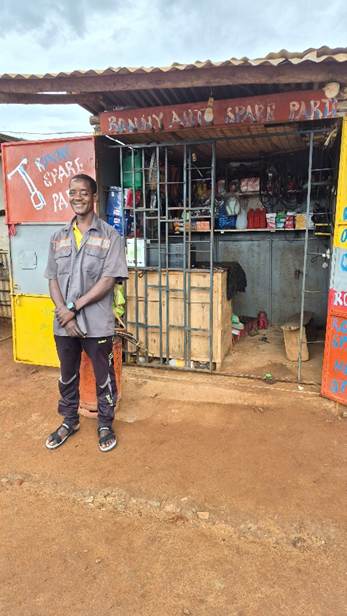
The common thread among these three borrowers is a husband who is supportive of his wife’s economic needs and ambitions. Edith Kyamukama’s husband, Caleb, works for Edith in her fishing business. Molly Tusiimirwe’s husband, Innocent, provides his banana plantation as collateral for the loan for Molly’s tailoring business. Loni Mumpe used the profits of his business to help his wife, Patience, start her own beauty salon. All three of these families are advancing economically in part due to a supportive husband. We saw several additional examples of this during our partner visits in October 2025. The team members of our MFI partners took note of these examples of supportive husbands as it is not at all a universal phenomenon in Uganda.
Women face significant social and economic challenges in Uganda because they tend not to be valued and supported across society. The gentlemen mentioned above are modeling the behavior that should be more widely embraced, and they deserve to be seen and acknowledged. In these cases, it appears that microfinance is amplifying the economic benefit of the gentlemen’s support of their spouses.
It is not clear to us how well recognized or widespread the phenomenon of supportive husbands in microfinance is. We intend to engage in a conversation with our partners to determine how widespread supportive spousal dynamics may be and how MFIs can encourage it. Any insights gained will be tremendously interesting.
Microfinance has long been recognized for providing loans to women who have little or no family support of their economic needs and ambitions. Group lending and micro-leasing loans are particularly effective in reaching women with no collateral or family support. This is an incredibly valuable role for microfinance, which we are excited to support. It appears that microfinance may also have a role in accelerating the economic advancement of families in which the husband is supportive of his wife. This would be a quiet and subtle, but extremely important contribution of microfinance. We look forward to gaining more insight into this topic.