

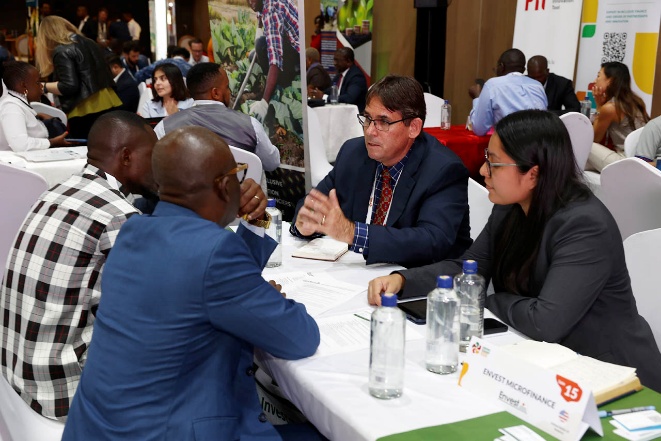
The seventh version of African Inclusive Finance Week, a biennial pan-African microfinance conference, took place in Nairobi, Kenya from October 13 – 17. Envest sent Annette Ecila, Elizabeth Rodriguez, and me to join over 1,100 attendees from all over the African continent and beyond.
The first three days consisted of sessions on current topics in microfinance, followed by an investors fair in which Envest was one of 24 participating investors. We attended the conference to meet with representatives of microfinance institutions (MFIs) that might be good lending partners as Envest grows and to hear the perspectives and trends of key players in the African microfinance sector.
In addition to the conference, Annette and I visited five out of Envest’s six partner MFIs in Uganda in the two weeks before the conference, and Annette, Elizabeth, and I visited Envest’s four partner MFIs in Kenya in the week and a half after the conference.
Significant need from strong MFIs on the African continent
During the investor fair, we met with representatives of more than 20 MFIs, several of which could be strong future partners. The following is a sample of the interesting MFIs we met.
- An MFI in eastern Kenya whose borrowers are 85% rural and 76% women. The primary focus of the portfolio (80%) is small business, and a modest portion of the portfolio is dedicated to renewable energy, water catchment, and education.
- An MFI in Nigeria that lends mostly to women (92% of the portfolio) in rural areas and urban slums. A significant proportion of the borrowers is illiterate, and these borrowers benefit from literacy training programs offered by the MFI. Most of the portfolio is focused on business with a significant portion being used to finance machinery, especially sewing machines. Few borrowers have collateral, and the machines being financed can serve as collateral.
- Another MFI in Nigeria that lends 90% to women and 80% in rural areas. The portfolio is primarily business, especially food processing, trade, and healthcare. Borrowers must have a bank account, and the MFI offers assistance in opening an account for new borrowers. Health programs are available to borrowers. One service available through the health program is access to sanitary pads, which can be difficult to obtain otherwise.
- An MFI in Mauritania that has a strong focus on the economic empowerment of women and youth. About 76% of borrowers are women, which is very impactful in a conservative, Muslim country. Lending is focused on income generating activities. Only 20% of the demand for loans is satisfied in Mauritania. There is a huge opportunity for impact with access to additional financial resources.
- A gender focused MFI in Ethiopia. Ethiopia has laws that preclude moving money out of the country, which precludes the participation of international lenders like Envest. There is a movement to reverse these laws, which would make Ethiopia a possible destination for Envest’s lending capital.
- We learned about MFIs in Ghana, Sierra Leone, and Guinea that could grow and serve more people with access to additional lending capital.
This is only a small subset of the high quality, small MFIs that we met that could serve far more people if they had additional financial resources. Envest has more demand from current partners than resources to lend. If Envest were to grow by $3 million, we could consider expanding our portfolio by lending to additional compelling MFIs that are having much needed impact.
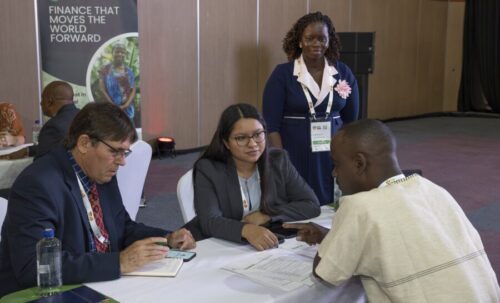
Key takeaways from sessions
Of the wide variety of topics presented in the sessions, four stood out to us as being particularly well represented: financing of agricultural production, climate change, inclusive insurance, and client training.
Agriculture featured over service sector
Several trends emerged throughout the sessions, the most notable being a strong focus on financing agricultural production. This was expected given the relatively early development stage of many African economies. More surprising to us was the limited attention on financing for small businesses and the development of the service sector, which typically drives long-term economic growth. We saw a great deal of focus on shifting to the service sector during our visits to our partner MFIs, but this trend was not reflected in conference discussions.
The need for reliable microinsurance
There was considerable discussion of insurance, which often flowed from discussions of climate change. Life insurance is commonly embedded into microfinance loans to protect the borrower’s family in the case of death. Crop insurance received the bulk of the attention at the conference. Several speakers addressed the issue of rejected claims and protracted claims processes, emphasizing the need for the microfinance sector to ensure that insurance providers handle reasonable claims promptly. Microfinance borrowers with little experience in formal economies tend to be suspicious of insurance products, and widespread rejection of reasonable claims could undermine both microinsurance and the broader microfinance sector. One speaker shared the interesting perspective that paying reasonable claims promptly serves as effective marketing, showing that its product is worthwhile.
Concessional credit featured over moving towards market rate
A surprising trend was the discussion of concessional credit and grants as being necessary for financial inclusion, with little discussion on accessing capital markets. With an estimated $300+ billion gap between the supply and demand for microfinance credit, we believe that capital markets are the only source of financial resources sufficient to fill this gap. Envest will continue to focus on its mission of bridging the gap between microfinance and capital markets with the conviction that access to credit is the major need in the microfinance sector.
Growing minimum transaction sizes
The trend toward larger minimum transaction sizes in microfinance received considerable attention. This observation came against the backdrop that small microfinance institutions (MFIs) have very few options for financing from international lenders. Envest is one of very few international lenders serving MFIs with under $5M in total assets. While we would like to see more lenders in our niche, the sector appears to be moving in the opposite direction. Envest remains committed to supporting small, strong MFIs.
The missing middle
The ”missing middle,” small business lending involving larger than typical microloans and smaller than traditional bank loans, was the focus of a few sessions. This sector consists of borrowers who are too rich to be considered poor and too poor to be considered rich. This gap is a legitimate concern, and several of Envest’s MFI partners plan to support growing businesses with progressively larger loans while continuing to serve low-income borrowers.
Client training
There was a great deal of discussion bordering on complaints that MFIs need to provide more training to borrowers, especially in financial literacy. Annette, Elizabeth, and I were somewhat perplexed by this topic because virtually all of Envest’s partner MFIs provide financial literacy training. Either Envest is lending to a much more progressive subset of the microfinance sector than we realized, or financial literacy training is more common than many speakers realized.
Africa Inclusive Finance Week was an excellent opportunity for us to learn about encouraging trends and items of concern. Our partnerships with MFIs will be stronger as a result of the perspective gained at the conference.